
Dot meow: the next queer corner of the Internet
The Internet loves cats. Loves them. So much so that a Belgian nonprofit called the dotMeow Foundation raised well over $100k from nearly 2,000 people in a Kickstarter campaign to own and run a queer, cat corner1 of the Internet: .meow
We’re applying to ICANN to operate .meow - we want to create a top-level domain where 100% of our profits fund LGBTQIA+ community infrastructure.
Soon, if all goes according to plan, you’ll be able to register domains like right.meow or thecats.meow. And the internet will be a little sillier, or in their words: “weird, fun, cats—not as...commercial.” But the commercial side of this is interesting, too. What does it even mean to own .meow?
Right meow there are 1,592 top-level domains, or TLDs—the part to the right of the dot—like .com or .org. Over a thousand of those came from an open round in 2012 where any organization could apply and bid for .whatever. That’s when Google paid $25 million for .app and when .blog, .sex, .baby, and hundreds of other extensions came to be. This year, 2026, is the first time since 2012 that companies can again apply to own a piece of the Internet’s domain namespace.
The dotMeow Foundation’s application is novel in a few ways:
- Their word choice is an oblique nod to their community, unlike the overt
.gayand.lgbt - They crowdfunded the application fee (and then some) and intend to run
.meowforever - They publicly announced the word they’re applying for, inviting or discouraging competition
It costs $227k to even apply for a TLD, but there is financial aid available, which dotMeow has already been approved for, so they’ll pay more like ~$50k in base costs2. If it works out, they plan to charge around $22-32 per year to register .meow domains, so they should make back their initial investment with a few thousand registrations. And who will those registrants be?
Selling Subarus to lesbians
Just like anyone can buy a Subaru, anyone will be able to buy a .meow domain.
We’re applying for a gTLD with open registration, meaning that anyone can register a .meow domain and do with it what they wish (within legal limits, of course).
The idea is not that all .meow domains will be for overtly queer things—although plenty of them will—but that the profits will fund queer things, through grants and what not. That said, an expressive domain can be used for signaling. By making a home on marshall.meow, for example, Marshall might be signaling that they are a member or ally of the LGBTQIA+ community. Meow is not universal slang for gay, obviously, so it’ll be more of an insiders’ nod, like when “Subaru spent more than a decade carefully targeting lesbian consumers” in the 90s and 2000s.
And while .gay can feel loud or limiting, .meow is playful and versatile — a subtle signal of solidarity, a wink to those in the know. We want it to become shorthand for “this person or org has our backs.”
.gay and .lgbt do exist already, btw: .lgbt is owned and run (100% for profit) by Identity Digital, the largest registry in the world with nearly 300 top-level domains, and .gay was originally owned and run (80% for profit) by Top Level Design (the registry side of Porkbun) and later sold to GoDaddy’s registry arm. Both came out in the 2012 round.
Where .gay donates 20% of proceeds to two large charities, .meow is structured so that every cent beyond operating costs goes back to queer communities.
And again, the Web is obsessed with cats, so the Internet cat machine could plausibly funnel substantial money into queer causes.
We chose .meow because it has a broad appeal. A tech company can register a .meow domain. A gaming community can. An artist can. We want to bring new money into queer mutual aid, not just redistribute existing resources. Every registration — whether it’s from someone building a personal site or a business establishing their online presence — will feed back into LGBTQIA+ community infrastructure.
.cat is a TLD, too—a longstanding one not for house cats but rather for Catalonia. Its registration is restricted to people demonstrating use or promotion of the Catalan language and culture.
Not for profit
This next line from dotMeow’s kickstarter may sound like corporatese (nonprofitese?), but it’s not to be taken for granted.
We have big dreams for what we will be able to achieve in the long term. We intend for this to be the project of our lifetimes.
So this is—supposed to be, at least—a lifetime investment, unlike registries who talk about “exiting” a TLD. That is, some registries talk about spending millions to bid for a TLD and run it, say, for a decade, before selling the “portfolio” to another registry.
We’re not a tech start-up looking for an exit. We’re not a corporation looking for profit margins. We’re a mission-driven organisation intent on building infrastructure that takes care of its own community.
As a registrant, a Joe Schmoe or a Pete or an Emilia, we can only ever renew a domain for 10 years maximum. It's the asterisk on “owning” your domain, because at the end of the day you are still beholden to and trusting the registry (safer than trusting a walled garden social media platform for your web presence, but still not 100% in your control). I can't be sure that Radix will still operate this .press domain a decade from now or whether they will have “exited” by selling the porfolio to another registry who'll hike up prices or neglect stability (but in fairness, that buyer could be an even more trustworthy steward). So I think it means something that dotMeow is at least pledging to run .meow forever. If their application succeeds...
Game theory
I gather that it’s unusual for a registry to announce application plans ahead of time. I could see it either inviting competition (“hm .meow, not a bad idea—the internet loves cats”) or discouraging it (“eh, let’s not bother with the hassle of contention for that one”). The pre-announcement also gets the wheels turning for registrations down the line.
We’re confident there’s demand, it is part of why we’re running this Kickstarter is so we can demonstrate that interest already exists to potential registrar partners.
.meow is a “Community” gTLD in ICANN jargon, meaning it’s supposed to be “operated for the benefit of a clearly delineated community.” That means if other businesses apply for the string, dotMeow can move to the front of the line with a “Community Priority Evaluation” (which costs another $50-80k conditional fee, discounted by dotMeow's financial aid). The only way they’d lose if they pull this lever is to another Community applicant.
So in all likelihood, soon you’ll be able to spin around several times before nesting down on your own .meow domain.
***
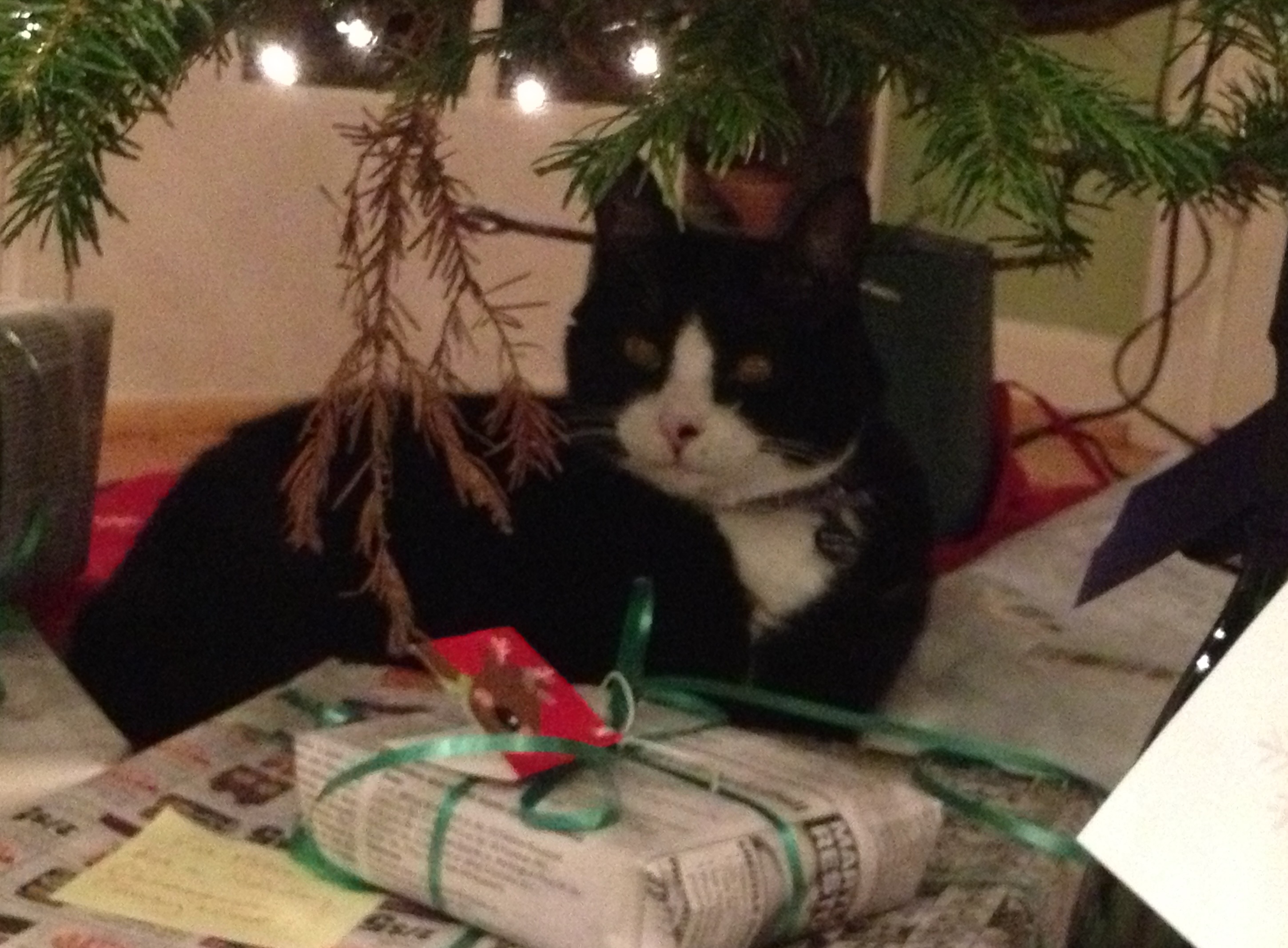
In memory of Jack the one-eyed cat, my childhood cat, who still had two eyes when this picture was taken in December 2012.
***
Footnotes
(1) Cat corner, not to be confused with kitty-corner.
(2) They were accepted into ICANN’s Applicant Support Program, so the $227k application fee will be discounted by 75%-85% to $34-57k. In practice, winning and running a TLD will cost much more than that with conditional fees and operational costs. And there’s no guarantee you’ll win! Other applicants could compete for .meow, for example.